
Dental Bridge or Implant: Which Option Fits Your Situation?
Neither a bridge nor an implant is automatically better. How neighbouring teeth, bone, treatment time and maintenance should shape your choice.
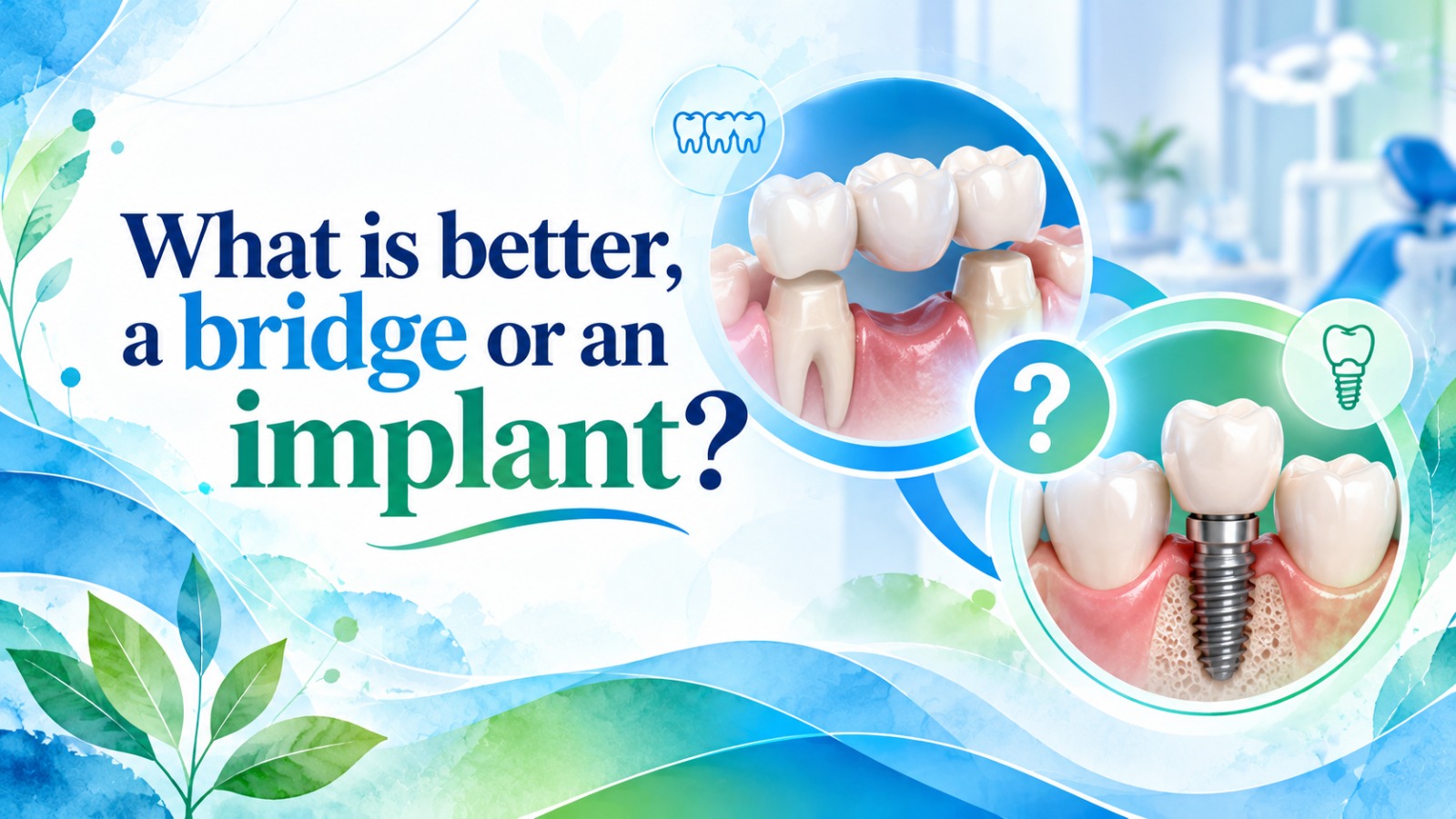
A dental bridge and a dental implant can both replace a missing tooth, but neither is automatically the better choice. An implant may be preferable when the neighbouring teeth are healthy and there is enough jawbone for placement. A bridge may make more sense when nearby teeth already need crowns, implant surgery is unsuitable, or a shorter treatment process is important.
The condition of your remaining teeth, gums and jawbone matters as much as the missing tooth itself.
Before deciding, it helps to understand how each option works, what treatment involves, how the costs differ and what you will need to maintain over time.
Dental Bridge vs Implant: What's the Difference?
A dental bridge replaces a missing tooth by attaching an artificial tooth to supporting teeth or other suitable structures.
A traditional bridge typically uses teeth on either side of the gap. These supporting teeth, called abutment teeth, are prepared for crowns that hold the artificial tooth, or pontic, in position.
A dental implant replaces the missing tooth root with a fixture placed in the jawbone. After the implant has achieved the required stability and healing, it can support a replacement crown.
The main difference is the foundation. A traditional bridge relies on neighbouring teeth for support. A single-tooth implant is supported by the jawbone and does not normally require those neighbouring teeth to be prepared for crowns.
Both can restore appearance and chewing function, but they involve different treatment requirements and long-term considerations.
Dental Bridge vs Implant: Side-by-Side Comparison
- Support: a bridge usually relies on neighbouring natural teeth; an implant uses a fixture placed in the jawbone.
- Surgery: a conventional bridge usually does not require it; an implant requires surgical placement.
- Neighbouring teeth: traditional bridges usually require tooth preparation; implants usually avoid preparing neighbouring teeth.
- Treatment time: a bridge is generally shorter; an implant may require several months, depending on healing.
- Bone requirements: a bridge does not normally require bone for implant placement; an implant requires adequate bone support.
- Initial cost: a bridge is often lower; an implant is usually higher.
- Cleaning: a bridge needs special cleaning beneath it; an implant needs careful care around the implant and crown.
- Long-term concerns: for a bridge, decay or problems affecting supporting teeth and bridge damage; for an implant, gum inflammation, peri-implant disease, and implant or crown complications.
- Replacement: a bridge may need repair or replacement; an implant's crown or other components may need maintenance or replacement.
These are general differences between traditional tooth-supported bridges and single-tooth implants. Other designs, including resin-bonded and implant-supported bridges, have different requirements.
When Might a Dental Bridge Be the Better Option?
A dental bridge may be a sensible choice when the condition of the nearby teeth, your health or your treatment priorities make an implant less suitable.
1. The neighbouring teeth already need crowns. Consider a patient who has lost one tooth and has heavily restored teeth on either side of the gap. If those neighbouring teeth already need crowns, a conventional bridge may address several restorative needs within one treatment plan.
This does not mean every heavily filled tooth is suitable for supporting a bridge. The dentist still needs to assess the remaining tooth structure, root health, gum support and bite. A bridge supported by unhealthy teeth may create problems later.
2. Implant surgery is not appropriate right now. An implant requires sufficient supporting bone and suitable conditions for surgery and healing. Active gum disease, poorly controlled medical conditions, certain medications or other clinical concerns may mean implant treatment should be delayed, modified or avoided. A bridge may be considered when suitable supporting teeth are available and implant treatment is not appropriate.
It is worth distinguishing a temporary obstacle from a permanent one. Some problems can be managed before implant treatment, while others may make an alternative more sensible. For a closer look at these situations, see: Why Might a Dentist Recommend Delaying or Avoiding a Dental Implant?
3. You prefer a shorter treatment process. A conventional bridge generally takes less time than a staged implant procedure. Bridge treatment typically involves preparing the supporting teeth, taking records or impressions, fabricating the restoration and checking the final fit. Implants involve surgical placement and, in many cases, a healing period before the final crown is attached.
If treatment needs to be completed within a limited period, a bridge may be more practical. However, speed should not be the only reason for choosing it.
4. A resin-bonded bridge may be suitable. Not every bridge requires the same amount of tooth preparation. A resin-bonded bridge, sometimes called a Maryland bridge, uses a bonded framework or wing to attach a replacement tooth to one or more neighbouring teeth. It may be considered for selected missing front teeth, particularly when preserving healthy tooth structure is a priority.
However, resin-bonded bridges have their own limitations. Bonding strength, available enamel, bite forces and tooth position all affect suitability. They may also become debonded and require reattachment or replacement. The dentist should explain whether this design is appropriate rather than assuming every missing tooth requires a conventional bridge.
When Might a Dental Implant Be the Better Option?
Implants may offer particular advantages when neighbouring teeth are healthy, supporting bone is adequate and the patient is suitable for surgical treatment.
1. You want to preserve healthy neighbouring teeth. Suppose one tooth is missing between two otherwise healthy teeth. A conventional bridge may require removing healthy tooth structure from those adjacent teeth to make room for supporting crowns. A single dental implant can replace the missing tooth without using the neighbouring teeth as supports. For someone with healthy teeth on either side of the gap, this can be an important reason to consider an implant.
2. There is enough healthy jawbone. An implant requires suitable bone for stable placement. The dentist assesses the quantity and quality of available bone, the position of nearby tooth roots, the bite and the surrounding tissues before deciding whether placement is appropriate. For some patients, the existing bone may be sufficient. Others may need bone grafting or additional procedures, which can affect treatment time, complexity and cost.
3. You want a replacement supported independently of other teeth. A single implant supports its own crown rather than transferring support through crowns on neighbouring natural teeth. This may be useful when those teeth are healthy and would not otherwise need restorative treatment. It does not mean implants are completely independent of the rest of the mouth. Bite forces, gum health, cleaning and the condition of surrounding tissues still affect their long-term performance.
4. Your long-term treatment goals support an implant. An implant may be worth considering when preserving adjacent teeth and establishing a long-term replacement are important priorities. However, long-term value is not the same as a guarantee of permanence. Implant restorations need regular maintenance. The surrounding tissues can develop inflammation or disease, and the crown may eventually need repair or replacement.
You can learn more about the maintenance factors in: How Long Do Dental Implants Last, and What Affects Their Lifespan?
What If You Have Bone Loss Where the Tooth Is Missing?
Bone loss can change the available treatment options. After a tooth is lost, the jawbone in that area may gradually change because it no longer receives the same functional stimulation through the missing tooth root.
A dental implant can help support bone around the implant when successfully integrated and functioning. It does not, however, prevent every form of future bone change. If too little bone remains for appropriate implant placement, bone grafting or another surgical approach may be considered.
A conventional bridge does not require an implant fixture to be placed into the missing-tooth area. That can make it an alternative when implant placement would require extensive additional surgery. But a bridge does not provide the same bone-supported replacement as an implant.
The decision should consider whether bone augmentation is appropriate, what the alternatives involve and what the patient is comfortable undertaking.
What If You Are Missing More Than One Tooth?
The choice becomes more complicated when several teeth are missing. A traditional bridge may replace more than one tooth, but the length of the gap and strength of the supporting teeth affect whether that design is appropriate.
Implants can also support multiple replacement teeth. In selected cases, two or more implants may support an implant-supported bridge rather than placing one individual implant for every missing tooth. That distinction matters:
- A tooth-supported bridge relies on natural teeth.
- An implant-supported bridge relies on dental implants.
- Individual implant crowns replace teeth separately where clinically appropriate.
These are different restorative designs with different costs, maintenance requirements and treatment plans. If several teeth are missing, an assessment of the entire area may be more useful than choosing a replacement for each gap separately.
Which Lasts Longer: A Dental Bridge or an Implant?
Dental implants can provide long-term tooth replacement, but neither implants nor bridges should be described as permanent or maintenance-free.
A bridge's lifespan depends on the condition of its supporting teeth, the fit of the restoration, bite forces, oral hygiene and whether problems such as decay develop around its margins. An implant's long-term performance depends on bone and gum health, implant position, healing, bite forces, medical factors, smoking and maintenance.
It is also important to distinguish the implant fixture from the crown attached to it. An implant may remain stable while its crown eventually requires repair or replacement. Similarly, a bridge may need replacing because a supporting tooth develops a problem, even if the bridge material itself has not fractured.
Published lifespan estimates vary because different studies examine different types of restorations, patients and follow-up periods. For an individual patient, the more useful question is: what could cause this particular restoration to fail, and how can those risks be managed?
What Are the Risks and Maintenance Requirements?
Both treatment options need routine care, but the areas requiring attention differ.
Caring for a dental bridge. A bridge requires careful cleaning around the supporting teeth and underneath the artificial tooth. Food and plaque can accumulate in spaces that are difficult to reach with normal brushing. Floss threaders, interdental brushes or other cleaning aids may be recommended. Potential complications include:
- Decay around supporting teeth
- Gum inflammation
- Loosening or loss of cementation
- Fracture or wear of the restoration
- Problems affecting the nerves or roots of supporting teeth
Regular dental reviews help identify issues before they become more difficult to manage.
Caring for a dental implant. An implant cannot develop a cavity in the same way as a natural tooth, but the surrounding gums and supporting bone can still develop disease. Inflammation around implants may begin in the soft tissues. In some cases, it can progress to involve supporting bone. This is known as peri-implant disease.
Brushing, appropriate cleaning around the implant, professional maintenance and reporting changes such as bleeding, swelling or looseness are important. The American Academy of Periodontology explains how peri-implant inflammation can affect long-term implant health.
Neither treatment should be chosen on the assumption that it can be forgotten once fitted.
Dental Bridge vs Implant Cost: Which Is More Affordable?
A conventional bridge often has a lower initial cost than a dental implant, but the overall financial comparison depends on the actual treatment plan.
For a bridge, cost may depend on:
- Number of replacement teeth
- Number and condition of supporting teeth
- Restoration material
- Laboratory work
- Whether supporting teeth need additional treatment
For an implant, the estimate may include:
- Assessment and imaging
- Surgical placement
- Implant fixture
- Abutment
- Final crown
- Bone grafting or other additional procedures, if required
At (Prof) Dr. Taranjit Kaur's Healing Touch Centre in Madgaon, the published dental implant cost guide lists an approximate ₹35,000–₹45,000 for a single-tooth dental implant, including the implant fixture, abutment and final crown under the standard plan. This is the clinic's published estimate, reviewed in July 2026, rather than a fixed quotation. Additional procedures may be charged separately.
A verified bridge price is not provided here because it depends on the planned bridge design and individual treatment needs.
Should You Compare Only the Initial Price?
No. A treatment that costs less initially may require additional work later, while a higher initial cost does not guarantee fewer future expenses. When comparing quotations, consider:
- What treatment is included
- Whether healthy teeth need to be prepared
- Whether surgery or grafting is required
- Expected appointments and healing
- Cleaning and maintenance needs
- Potential future repairs or replacement
Ask for a clear estimate based on the treatment actually recommended for your mouth.
How Should You Decide Between a Bridge and an Implant?
Before making a decision, ask the dentist to assess the missing-tooth area together with the neighbouring teeth, gum condition, bone support and bite. A useful comparison starts with six questions:
- Are my neighbouring teeth healthy? If they are, preserving them may favour an implant or selected conservative bridge design.
- Do those teeth already need crowns? If so, a conventional bridge may deserve consideration.
- Is there enough bone for an implant? If not, ask whether grafting is appropriate and what alternatives exist.
- Would my medical history affect surgery or healing? Discuss medical conditions, medication and smoking before planning.
- How much treatment time can I reasonably allow? Consider both placement and any healing or follow-up.
- What can I maintain comfortably over time? Good cleaning and regular reviews matter whichever option you choose.
It is reasonable to ask the dentist to explain both choices even when one appears preferable at first.
Frequently Asked Questions
Can a dental bridge be replaced with an implant later? Sometimes, yes. The bridge and supporting teeth need to be assessed first. Implant placement will also depend on the available bone, gum health and space. Removing an existing bridge does not automatically mean an implant can be placed immediately.
Is a dental bridge a permanent replacement? A fixed bridge is intended to remain in place rather than being removed by the patient each day. However, it may eventually need repair or replacement. The health of the supporting teeth is particularly important.
Can you get an implant if you have diabetes? Diabetes does not automatically rule out an implant. The level of diabetes control, oral health, healing risk and other medical factors need assessment. Uncontrolled diabetes may increase complications and may require improved management before surgery.
Is an implant always better for a missing back tooth? No. Back teeth experience substantial chewing forces, so bone support, bite, available space and neighbouring teeth matter. Either a bridge or implant may be appropriate depending on the clinical situation.
Do you always need to replace a missing tooth? Not necessarily. The position of the missing tooth, chewing function, bite, condition of nearby teeth and risk of future problems should be assessed. Some patients may reasonably choose to leave a gap under professional guidance, while others benefit from replacement.
Making the Right Tooth Replacement Decision in Madgaon
A dental bridge may be an appropriate choice when neighbouring teeth already need restorative work, a non-surgical solution is preferred or implant treatment is not suitable. A dental implant may be preferable when the adjacent teeth are healthy, adequate bone is available and the patient is suitable for surgery and long-term maintenance.
"The most useful decision comes from understanding what each option would mean for your own teeth, not from choosing whichever treatment sounds more advanced."
At (Prof) Dr. Taranjit Kaur's Healing Touch Centre in Madgaon, Goa, Dr. Taranjit Kaur brings more than 25 years of clinical and academic experience in Oral & Maxillofacial Surgery, Dental Implant and TMD related care. If you are comparing a bridge and an implant, a consultation can help clarify the condition of the supporting teeth, available bone, treatment requirements and costs.
Learn more about dental implant treatment in Madgaon, or contact the clinic to discuss your options before deciding.
(Prof) Dr. Taranjit Kaur's Healing Touch Centre, Shop 37, Upper Ground Floor, Vasant Arcade, Comba, Madgaon, Goa 403601. Call: +91 87889 47831. Book a Tooth Replacement Consultation.
Keep reading
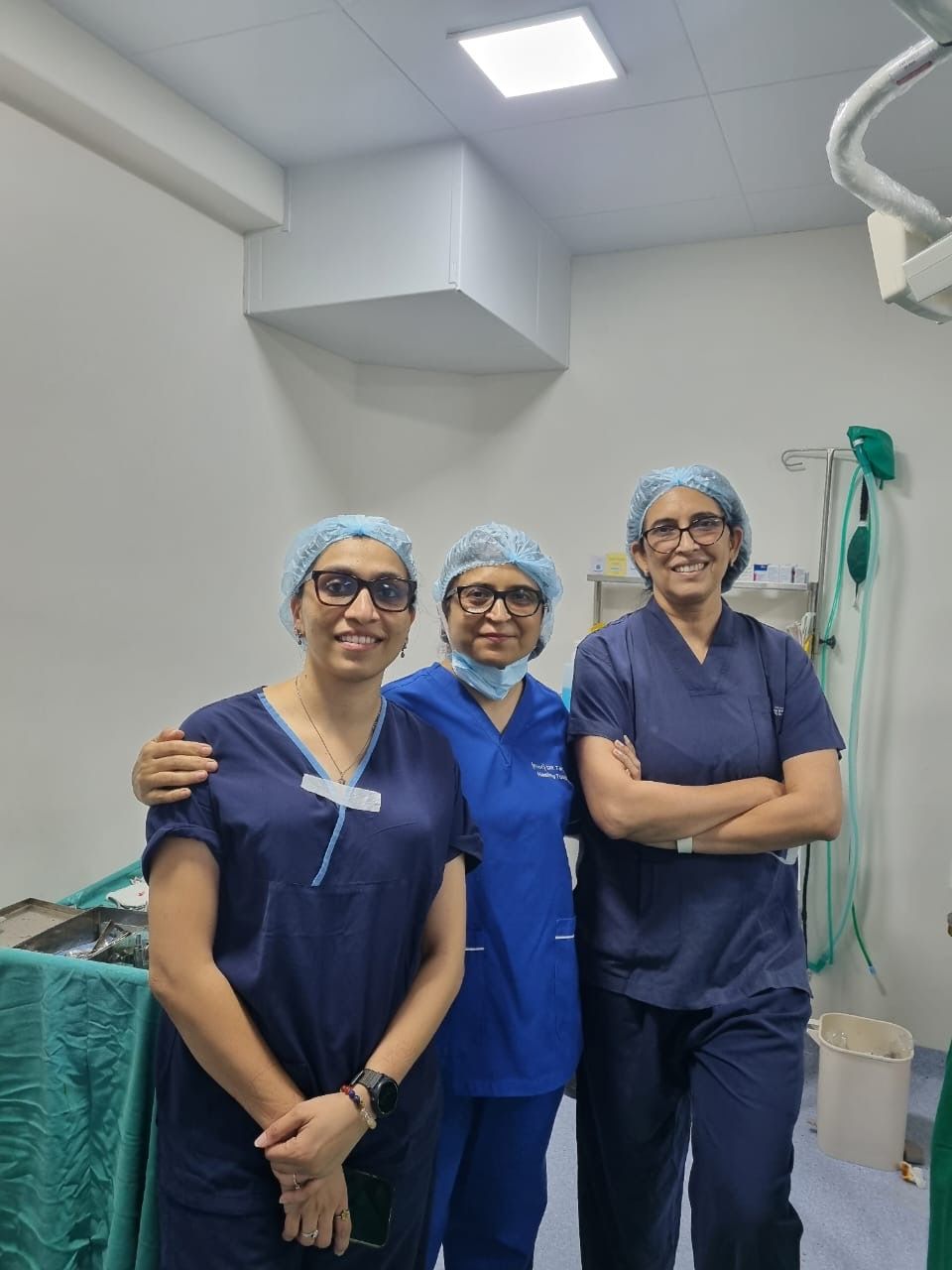
Women in Surgery
From a changing room that did not exist to an all-women surgical team — how the role of women in oral and maxillofacial surgery has changed in one career.

Is Bite Correction a Recommended Treatment Option for Patients with Jaw Pain?
Why full-mouth rehabilitation is not an evidence-based cure for TMD — and what the guidelines actually recommend for jaw pain.