
Is Bite Correction a Recommended Treatment Option for Patients with Jaw Pain?
Why full-mouth rehabilitation is not an evidence-based cure for TMD — and what the guidelines actually recommend for jaw pain.
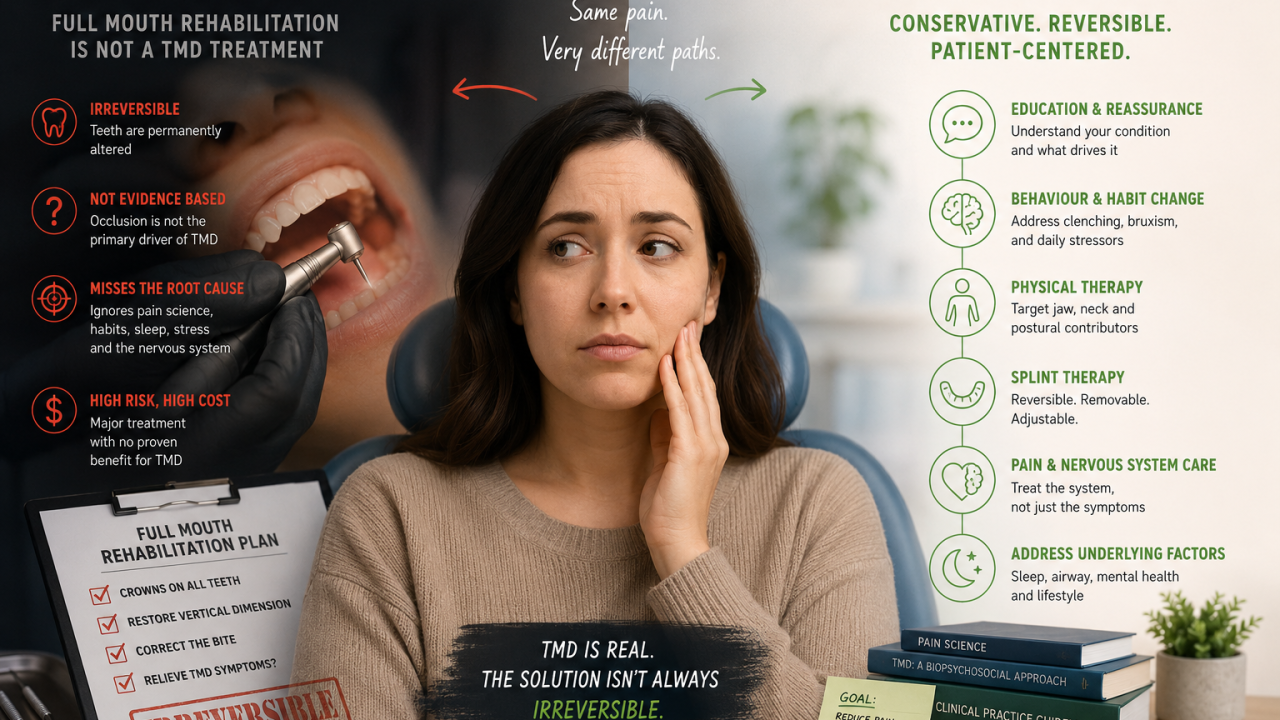
A patient walks in to a clinic with jaw pain. Clicking. Wakes up with morning headaches at times, a stiff neck, trouble opening her mouth wide. She has already seen a Neurologist who refers her to a dentist saying that she has a jaw joint disorder which is managed by a Dentist better. And somewhere along the way, she has been told that it's her bite that is the main problem — that her teeth don't meet correctly, that years of wear have "collapsed" her vertical dimension (VD) and caused an uneven bite (or cant) in medical terms, and that the real fix is a full mouth rehabilitation: crowns, maybe on every tooth, to "rebuild" her bite from scratch. A treatment that would cost her a lakh and half if not less.
She trusts her dentist. As most patients do, and they should be able to. So she says yes.
This scenario is becoming common enough that it deserves a plain, evidence-based conversation — not because any individual clinician is acting in bad faith, but because a treatment philosophy has taken root that isn't supported by where the science on temporomandibular disorders (TMD) actually stands today.
What does the evidence actually say?
Dentistry is deeply rooted in the biomedical model of science where cause and effect are linear and visible. There is a tooth which has a cavity, either fill it or remove it and replace it. Teeth are crooked, mal-aligned, remove some teeth, put braces and you are done. Direct and linear.
We are taught to look at causes in the structures and not in processes. What caused it — the process — was somehow missed. It's only now that as functional dentistry is gaining inroads into our practice that we are gaining some insights into the multidimensionality of processes.
For this reason for decades, Dentistry searched for a single mechanical cause of TMD — a "bad bite," a missing back tooth, an occlusion a few microns off. It was an appealing idea, because it offered a fix dentists are trained to provide: alter the occlusion, and the pain should resolve.
It hasn't held up. Major bodies including the American Academy of Orofacial Pain (AAOP) and the international Diagnostic Criteria for TMD (DC/TMD) research consortium now frame TMD as a biopsychosocial condition — closer in mechanism to other chronic musculoskeletal pain conditions (like low back pain or tension headache) than to a structural dental problem. Occlusion is, at most, a minor and inconsistent contributing factor. It is not the primary driver, and irreversibly altering it is not a validated ethical way to treat the pain.
The contributing factors that the evidence does support are different in kind:
- Parafunctional habits — clenching, bruxism, often linked to stress, sleep disorders, or airway issues.
- Central sensitisation — a nervous system that has become hyper-responsive to pain signals, independent of ongoing tissue damage.
- Psychosocial load — anxiety, depression, poor sleep, and life stress, all of which are reproducibly associated with TMD severity and chronicity.
- Joint-specific pathology — in a minority of cases, genuine intra-articular disease, which has its own diagnostic pathway and is not treated by reshaping unaffected teeth.
None of these are corrected by full mouth rehabilitation. None of them.
The treatment ladder dentistry is supposed to follow
Reputable guidelines are explicit and consistent on this point: TMD management should start conservative and reversible, and stay there unless there is a specific, well-documented structural indication to do otherwise.
That means, in roughly this order: patient education, behavioural and habit modification, physical therapy, occlusal splints (reversible, removable appliances — not permanent restorations), pain management addressing the nervous system component, and where appropriate, referral for the psychological or sleep-related contributors. Irreversible occlusal treatment is reserved for narrow circumstances and is not a first-line, or even a routine, response to jaw pain.
Full mouth rehabilitation is a major, irreversible undertaking. It involves preparing and crowning multiple — sometimes all — teeth, and justifies its claims of "restoring vertical dimension" or "correcting the bite" to relieve TMD symptoms.
Full mouth rehab has real indications when used appropriately: severe pathological wear, collapsed posterior support from missing teeth, or extensive failing dentition. TMD pain alone is not one of them.
When it's offered as a TMD cure, several things tend to be missing: a validated DC/TMD diagnostic workup, screening for parafunction and sleep-disordered breathing, any psychosocial assessment, and — critically — a documented trial of reversible therapy that was mandatory, which when failed, a referral to an Orofacial pain specialist is a moral duty.
Why this happens
I don't believe most clinicians offering this are acting cynically. Some genuinely believe the older occlusal-cause model, because that's what they were taught, or a postgraduate course they trusted and attended told them. And this is where the pattern becomes self-perpetuating: continuing education courses exist that present full mouth rehabilitation as the advanced, lucrative, "next-level" skillset every serious dentist should acquire — sometimes explicitly pitched at recent graduates as the trend to follow if they want a thriving practice.
A new graduate, eager to build a reputation and a patient base, sitting in a room where a respected senior clinician is teaching this with total confidence, has very little reason to question it. That is not a personal failing. It's exactly how unverified treatment philosophies spread in any profession — through trusted hierarchies, not bad intent.
What this means in practice
If you're a patient: jaw pain deserves a real diagnostic workup — ideally against DC/TMD criteria — before anyone touches your teeth permanently. A second opinion before committing to irreversible, expensive, multi-tooth treatment is not rude. It's standard practice for any major irreversible medical decision, and TMD treatment should be no different.
If you're newly qualified: it is worth asking, of any course or mentor, a simple question — where is the published evidence that this specific treatment resolves TMD, as opposed to opinion, case series, or tradition? Confidence in a lecture hall is not the same as evidence. The biopsychosocial model isn't a trend either, for what it's worth — it's simply where thirty years of pain research has landed, across every chronic pain condition we've studied closely.
"Patients trust us with decisions they cannot fully evaluate themselves. That trust is the whole foundation of informed consent, and it is also exactly why irreversible treatment for a condition with a well-documented conservative pathway deserves more scrutiny than it is currently getting."
Keep reading
Dental Bridge or Implant: Which Option Fits Your Situation?
Neither a bridge nor an implant is automatically better. How neighbouring teeth, bone, treatment time and maintenance should shape your choice.
Women in Surgery
From a changing room that did not exist to an all-women surgical team — how the role of women in oral and maxillofacial surgery has changed in one career.